Data Entry Services

ultimate guide for usa, uk, canada & australian businesses to outsource data entry to the philippines dmbp

Ultimate Guide for USA, UK, Canada & Australian Businesses to Outsource Data Entry to the Philippines

In today’s competitive business environment, companies across the USA, UK, Canada, and Australia are increasingly looking for smarter, cost-effective ways to manage essential workflows like data entry. From handling large volumes of customer records to updating complex spreadsheets, data management is critical yet time-consuming. This is where outsourcing data entry to the Philippines becomes a strategic advantage. In this ultimate guide, we’ll walk you through everything you need to know about partnering with a Philippines data entry outsourcing company — from benefits and process workflows to best practices and cost considerations. By the end of this post, you’ll be equipped to make an informed decision about scaling your operations safely, efficiently, and profitably. What Is Data Entry Outsourcing? Data entry outsourcing refers to delegating routine and high-volume data tasks to an external service provider rather than handling them internally. These tasks often include: For businesses in the USA, UK, Canada, and Australia, outsourcing allows internal teams to focus on core functions like strategy, sales, and customer engagement — while specialists handle the labor-intensive work. Why Outsource Data Entry to the Philippines? The Philippines has emerged as a global leader in outsourced data entry services, and there are several compelling reasons why businesses from Western markets choose Filipino providers: 1. Highly Skilled and English-Proficient Workforce Filipino professionals are known for their strong English language skills, cultural adaptability, and attention to detail. These qualities are crucial for handling data tasks accurately and communicating effectively with international clients. This makes the Philippines a desirable outsourcing partner for businesses from the USA, UK, Canada, and Australia, where English communication is essential. 2. Cost-Effective Data Entry Solutions Outsourcing to the Philippines offers significant savings compared to hiring full-time in-house staff in Western countries. By leveraging affordable data entry services, companies can: This allows businesses to reallocate resources toward growth areas like marketing, customer support, and product development. 3. High Quality and Accuracy Accuracy is a non-negotiable requirement for any data entry project. Philippines-based outsourcing companies are experienced in delivering high-accuracy data entry services, backed by quality checks, validation protocols, and performance monitoring systems. This ensures that the data you receive is reliable, consistent, and ready for business use. 4. Flexible Scalability Business needs fluctuate — especially in industries like eCommerce, healthcare, finance, and logistics. Outsourcing providers in the Philippines offer flexible solutions that can scale up or down depending on project demand — without the hassle of hiring or layoffs. 5. Time Zone Compatibility The Philippines’ geographic location provides strategic time zone advantages for global businesses. Filipino teams can overlap with working hours in the USA, UK, Canada, and Australia — enabling timely communication, faster turnaround times, and seamless collaboration. Key Data Entry Services You Can Outsource to the Philippines Here’s a breakdown of common outsourced data entry services that businesses frequently delegate to Filipino providers: 1. Manual Data Entry Manual data entry is ideal for unstructured or complex information that requires human judgment — such as handwritten forms or historical records. 2. CRM Data Entry Maintaining accurate CRM (Customer Relationship Management) data is essential for sales, marketing, and customer support teams. Outsourcing CRM data entry ensures: 3. Excel Data Entry and Database Management From organizing spreadsheets to updating database systems, Excel data entry and database management help businesses maintain structured and accessible data. 4. Document Digitization and PDF Conversion Physical documents, scanned files, and paper records can be converted into digital formats — improving accessibility, searchability, and workflow efficiency. 5. E-commerce Data Management E-commerce stores often require frequent updates to product listings, pricing, inventory levels, and descriptions — all of which can be efficiently handled through outsourcing. Benefits of Outsourcing Data Entry for Western Businesses Let’s dive deeper into why outsourcing data entry to the Philippines is especially valuable for companies in the USA, UK, Canada, and Australia. 1. Boosts Operational Efficiency Outsourced data entry services free up internal teams to focus on high-value tasks. Your staff can spend more time on strategic initiatives, client engagement, and revenue-driving activities — ultimately improving overall productivity. 2. Improves Data Accuracy and Quality High-quality data is the backbone of effective decision-making. By partnering with experienced data entry specialists, businesses benefit from: Quality data supports better insights, forecasting, and business intelligence. 3. Enables Rapid Turnaround Time Philippines-based outsourcing teams are equipped to handle large volumes of work within tight deadlines. Whether you need daily updates or high-volume batch processing, outsourcing ensures faster delivery without sacrificing accuracy. 4. Reduces Operational Risk Outsourcing providers follow established processes, security protocols, and confidentiality standards, reducing the risk of errors, data loss, or compliance issues. 5. Enhances Business Continuity With flexible teams operating across multiple time zones, Philippines data entry providers ensure uninterrupted support — even during peak seasons or organizational transitions. How to Choose the Right Outsourcing Partner in the Philippines Selecting the right outsourcing provider is crucial for success. Here are practical criteria to help you make a confident decision: 1. Industry Experience and Track Record Look for companies with established experience in outsourced data entry services, especially those who have worked with clients in your region (USA, UK, Canada, Australia). 2. Communication and Language Proficiency Clear communication is essential. Ensure your partner has strong English language skills and reliable communication channels for consistent collaboration. 3. Data Security and Confidentiality Make sure the outsourcing provider follows secure data handling practices, confidentiality agreements, and compliance standards — especially if your business deals with sensitive information. 4. Scalability and Flexible Pricing Your business needs may change over time. Choose a partner that offers flexible engagement models and transparent pricing without hidden fees. 5. Technology and Systems Integration A good outsourcing partner should work with modern tools and software for seamless data transfer, tracking, and quality assurance. Best Practices for Successful Data Entry Outsourcing Projects Once you’ve selected a provider, these best practices will help maximize the value of your outsourcing engagement: 1. Provide Clear Instructions and Standards Clear documentation, standard operating procedures, and well-defined data guidelines reduce confusion and improve consistency. 2.
Ultimate Guide for USA, UK, Canada & Australian Businesses to Outsource Data Entry to the Philippines Read More »

the role of rpa & intelligent document processing in philippine bpo dmbo

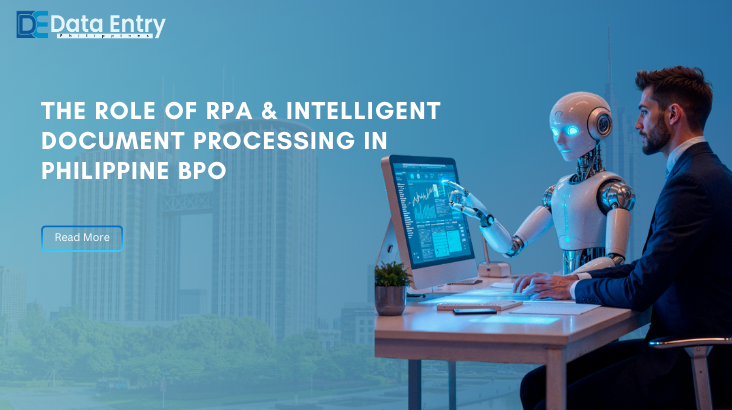
The Role of RPA & Intelligent Document Processing in Philippine Bpo

As organizations around the world — especially in the USA, Canada, UK, and Australia — scale their operations, the demand for smarter, faster, and more accurate business solutions has never been greater. In the global business process outsourcing (BPO) landscape, the Philippines continues to be a top destination for companies seeking reliable and cost-effective support. But in today’s evolving technology environment, traditional outsourcing isn’t enough. Emerging technologies like Robotic Process Automation (RPA) and Intelligent Document Processing (IDP) are transforming how BPO services are delivered — increasing efficiency, accuracy, and scalability for enterprise clients across industries. In this blog, we’ll explore the pivotal role of RPA and Intelligent Document Processing in Philippine BPO, why these innovations matter for global businesses, and how Philippines-based outsourcing providers (including data entry services) are leveraging them to create measurable impact. Understanding RPA and Intelligent Document Processing Before we dive into the Philippine context, let’s clarify what these technologies are: What Is Robotic Process Automation (RPA)? Robotic Process Automation (RPA) refers to software robots or “bots” that automate repetitive and rule-based tasks previously done by humans. RPA works especially well for processes such as: RPA is not artificial intelligence, but it often complements AI when combined with tools like machine learning and Natural Language Processing (NLP). What Is Intelligent Document Processing (IDP)? Intelligent Document Processing (IDP) goes beyond basic automation. It combines AI, OCR (Optical Character Recognition), NLP, and machine learning to extract information from complex, unstructured documents like: With IDP, systems can interpret and classify content, not just read static text. Why RPA and IDP Matter in the BPO Industry Integrating RPA and Intelligent Document Processing into outsourced workflows dramatically boosts productivity and accuracy. Here are the core advantages that global companies care about: 1. Faster Turnaround Times Manual, repetitive tasks slow down operations. When Philippine BPO providers implement RPA and IDP solutions, processes that once took hours can be completed in minutes. This accelerates service delivery, particularly for industries with strict timelines such as healthcare, banking, and insurance. 2. Enhanced Accuracy and Reduced Errors Human error is unavoidable — especially with large volumes of data. By leveraging RPA and intelligent technologies, BPO firms can significantly improve data accuracy and eliminate inconsistencies that could impact compliance or analytics. 3. Scalable Operations RPA bots can be deployed rapidly and scaled up based on workflow demands. Combined with IDP, Philippine BPO centers can handle peak workloads without sacrificing quality — a major benefit for clients in North America, Europe, and Australia. 4. Lower Operational Costs By reducing manual effort and increasing throughput, organizations can enjoy lower costs without compromising delivery standards — a key factor driving the popularity of outsourcing to the Philippines. 5. Increased Compliance and Security Automated processes improve traceability, audit trails, and documentation standards — all of which are crucial for regulated industries like finance and healthcare. How Philippine BPO Providers Are Using RPA & IDP Streamlined Data Entry and Data Management Philippine outsourcing teams that specialize in data entry services are now integrating RPA with IDP to capture, validate, and organize data from various sources — including forms, PDFs, emails, and handwritten documents. This means: For global companies that rely on real-time data, this is a game changer. Efficient Invoice and Billing Processing Many businesses still struggle with manual invoice processing — a time-consuming and error-prone task. With Intelligent Document Processing, Philippine BPO firms can automatically extract invoice data and route it through an RPA-driven workflow for review and approval. Benefits include: Better working capital management Improved Compliance for Regulated Industries Regulated sectors such as healthcare, insurance, and financial services require precise documentation and strict adherence to policies. RPA and IDP help ensure that: This gives clients peace of mind when outsourcing sensitive processes overseas. Smarter Customer Support and Back-Office Automation RPA bots empower customer service teams by automating repetitive tasks like: With underlying IDP technology, even customer communications received in text-heavy documents or emails can be automatically categorized and processed. Real-World Impact: Case Examples To make this more concrete, consider these typical scenarios where automation provides measurable benefits: Healthcare Administration A healthcare provider in the USA outsources patient record processing to a Philippine BPO partner. With RPA + IDP: The result? Clinicians spend more time on patient care and less time on paperwork. Banking and Finance A Canadian financial institution leverages Philippine outsourcing to process loan applications: This speeds up lending cycles and strengthens client satisfaction. Why the Philippines Is Perfect for This Automation Shift The Philippines has become a global leader in BPO — and now in RPA and Intelligent Document Processing adoption — for several reasons: 1. Highly Skilled Workforce Filipino professionals are known for their strong English proficiency, technological adaptability, and attention to quality — all essential for hybrid human-automation workflows. 2. Existing BPO Infrastructure With decades of outsourcing experience, the Philippines already hosts advanced delivery centers, technology frameworks, and cross-border collaboration capabilities. 3. Cost-Efficiency + Innovation Organizations enjoy cost advantages while accessing cutting-edge automation — a combination that sets Philippine providers apart from competitors. 4. Cultural Alignment With Western Markets Strong cultural compatibility with USA, UK, Canada, and Australia helps reduce friction in communication, expectations, and delivery standards. Best Practices for Implementing RPA & IDP With a BPO Partner If your organization is considering leveraging RPA and Intelligent Document Processing through a Philippine BPO firm, here are key best practices: 1. Start With Clear Process Mapping Identify repetitive, high-volume tasks that are best suited for automation. Map existing workflows before introducing technology. 2. Balance Automation With Human Oversight Not all tasks should be fully automated. Combine RPA + IDP with expert human review to ensure accuracy — especially with complex data. 3. Invest in Training and Onboarding Work with your BPO partner to ensure staff understand both the technology and business context. 4. Measure KPIs and Outcomes Track metrics like: This helps build continuous improvement cycles. Conclusion The integration of Robotic Process Automation (RPA) and Intelligent Document Processing (IDP) is reshaping the future of Philippine BPO services

The Role of RPA & Intelligent Document Processing in Philippine Bpo Read More »

how philippines data entry helps healthcare organizations focus on patient care dmbo

How Philippines Data Entry Helps Healthcare Organizations Focus on Patient Care

In today’s complex healthcare landscape — especially in the USA, Canada, UK, Australia, and other international markets — healthcare providers face mounting pressure to deliver exceptional patient care while managing massive volumes of medical records, billing information, and administrative documentation. Many healthcare organizations are turning to specialized Philippines data entry services to manage these critical back-office tasks effectively. By outsourcing healthcare data entry to experienced professionals in the Philippines, medical practices can reduce administrative burden, maintain high accuracy standards, and ultimately focus more time and resources on what matters most — patient care. In this comprehensive guide, we’ll explain how outsourcing data entry to the Philippines transforms healthcare operations, why Filipino professionals are ideal partners for medical organizations, the real benefits of this approach, and how it supports improved healthcare outcomes. What Is Healthcare Data Entry Outsourcing? Healthcare data entry outsourcing refers to assigning medical data tasks — like digitizing patient records, entering medical billing codes, transcribing treatment notes, or updating electronic health records (EHR) — to external professionals. When healthcare providers outsource these processes to skilled teams in the Philippines, they get: By delegating these essential yet time-intensive tasks to experts, healthcare teams can dedicate more energy to patient engagement, clinical decision-making, and strategic initiatives. Why Healthcare Organizations Outsource Data Entry to the Philippines 1. Highly Skilled and English-Proficient Workforce Healthcare documentation requires precision and clear communication. Filipino professionals are widely recognized for their fluency in English and strong technical skills — qualities that make them ideal for managing complex medical information for English-speaking countries like the USA, UK, Australia, and Canada. This high level of language proficiency helps eliminate misinterpretations and ensures accurate documentation — a key factor in quality patient care. 2. Cost-Effective Healthcare Data Entry Services Healthcare organizations often operate under strict budget limitations, especially nonprofits and smaller practices. Outsourcing medical data entry to the Philippines significantly reduces labor costs compared to in-house staffing in Western countries, without compromising quality and accuracy. This financial advantage allows healthcare providers to reallocate resources toward frontline services, advanced equipment, and enhanced patient care programs. 3. Strict Data Security and Compliance Standards Handling medical information involves strict compliance with regulations such as HIPAA (Health Insurance Portability and Accountability Act) in the United States and similar standards in other countries. Professional Philippines data entry teams are trained in secure data handling practices, encrypted workflows, and compliance-aligned processes, ensuring sensitive patient information is protected while still being accessible to authorized clinical teams. 4. Scalability and Flexibility Healthcare needs fluctuate — from routine checkups to emergency response situations — requiring adaptive support systems. Outsourcing data entry to the Philippines provides healthcare organizations with scalable solutions that can adjust to seasonal demands, high patient volumes, or special projects. Key Healthcare Data Entry Services Provided by Philippines Outsourcing Experts Below are essential healthcare data entry services that help medical providers streamline operations: 1. Medical Records Digitization Large hospitals and clinics manage millions of patient files. Converting paper-based files into electronic health records (EHR) ensures quick retrieval, better coordination among care teams, and improved clinical decision-making. Outsourced teams capture key details such as: Accurate digitization reduces errors and supports continuity of care. 2. Insurance and Medical Billing Data Entry Medical billing is complex, involving: Errors in billing code entry can lead to claim rejections, revenue loss, and administrative backlogs. Trained Philippines data entry professionals ensure accurate medical coding and billing support, helping healthcare providers receive timely reimbursements. 3. Transcription Services Doctors and nurses often dictate clinical notes, which must be converted into written records within patient files. Outsourced transcription services deliver: This ensures complete and reliable patient documentation. 4. Electronic Health Record (EHR) Management Up-to-date and accurate EHR systems are essential for coordinated care. Professionals in the Philippines support EHR updates, data validation, and information reconciliation — allowing clinicians to access the most current patient information. How Outsourcing Data Entry Helps Healthcare Organizations Focus on Patient Care 1. Reduces Administrative Burden Healthcare providers often spend countless hours on paperwork — hours that could otherwise be spent with patients. By outsourcing back-office data entry tasks, medical professionals can focus more on: 2. Improves Data Accuracy and Integrity Accurate healthcare records are non-negotiable. Errors in documentation can lead to misdiagnosis, billing issues, and poor patient outcomes. Outsourcing to specialized teams ensures: This allows clinicians to make decisions based on reliable information. 3. Enhances Operational Efficiency Philippines data entry teams work with optimized workflows and modern software tools, enabling faster processing of medical data. This improves operational KPIs — reducing backlogs, speeding claims processing, and minimizing administrative turnaround times. 4. Cost Savings Reinvested in Patient Services Outsourcing reduces overhead costs related to internal staffing, training, software licensing, and office infrastructure. The savings can be redirected toward: 5. Supports Compliance and Risk Management Outsourcing partners follow strict security protocols and documentation standards. This ensures critical medical and insurance data remains secure and compliant — reducing legal risk for medical organizations. Success Stories — Real Benefits of Healthcare Outsourcing to the Philippines Here are common outcomes reported by healthcare organizations using Philippines data entry services: Faster Insurance Claim Processing With accurate medical billing data entry and coding support, many clinics and hospitals see a reduction in claim rejection rates — resulting in improved cash flow and fewer billing disputes. Improved Clinical Documentation Quality With expert transcription and EHR management, care teams have easier access to complete clinical histories — enhancing communication among providers and improving patient outcomes. Greater Patient Satisfaction When clinicians spend more time with patients and less time on administrative tasks, patient satisfaction scores tend to rise — resulting in better clinical engagement and loyalty. Conclusion For healthcare organizations in the USA, Canada, UK, Australia, and beyond, outsourcing healthcare data entry services to the Philippines offers strategic advantages that go far beyond cost savings. From enhanced data accuracy and compliance to improved operational efficiency and patient care focus, Philippine data entry support enables medical teams to deliver high-quality healthcare where it matters most. By leveraging the expertise of

How Philippines Data Entry Helps Healthcare Organizations Focus on Patient Care Read More »

BPO and Data Entry Services in Philippines

Why Global Businesses Choose the Philippines for BPO & Data Entry Services

In a highly competitive global marketplace, businesses are constantly looking for smarter ways to manage operations, reduce costs, and maintain data accuracy. As digital transformation accelerates, the volume of business data continues to grow, making efficient back-office management more important than ever. This shift has led many organizations to outsource non-core tasks—and among all destinations, the Philippines for BPO & Data Entry Services has emerged as a clear global leader. From startups to multinational enterprises, companies across industries are increasingly relying on BPO services in the Philippines to support data-driven operations. The country offers a powerful combination of skilled professionals, cost efficiency, advanced technology, and a service-oriented culture that few outsourcing destinations can match. Strong English Communication and Skilled Talent Pool One of the primary reasons global companies choose BPO Philippines is the country’s strong command of the English language. English is widely used in education, business, and professional communication, allowing offshore teams to collaborate seamlessly with international clients. Beyond language proficiency, Filipino professionals are well-trained in handling complex workflows related to data entry services, data processing services, and back-office outsourcing. Their attention to detail, adaptability, and process discipline are especially valuable for businesses that depend on high data accuracy and consistency. This workforce advantage makes the Philippines an ideal destination for data entry outsourcing services that require precision, scalability, and long-term reliability. Cost-Effective Outsourcing That Drives Business Growth Cost optimization remains a key factor behind the global demand for outsourcing, and the Philippines delivers exceptional value in this area. Businesses can significantly lower operational expenses by partnering with cost-effective BPO services in the Philippines, without compromising service quality. Lower labor costs, flexible pricing models, and reduced infrastructure investments allow organizations to scale operations efficiently. For companies managing large volumes of information, offshore data entry outsourcing Philippines provides a strategic advantage by freeing internal teams to focus on core business goals such as innovation, customer experience, and revenue growth. This balance between affordability and quality has positioned the Philippines as a preferred hub for offshore data entry services worldwide. Specialized Expertise in Data Entry and Back-Office Services The Philippines has developed deep expertise in data entry outsourcing and back-office services, supporting diverse industries including healthcare, finance, insurance, logistics, real estate, and e-commerce. Filipino outsourcing teams routinely handle tasks such as online data entry, data cleansing, document digitization, OCR services, and database management. This specialization ensures that even high-volume or complex projects are managed with accuracy and efficiency. Global companies trust data entry outsourcing to the Philippines because service providers follow structured workflows, quality control processes, and industry best practices—resulting in consistent, dependable output. Time Zone Advantage and 24/7 Operational Support Another key reason global organizations prefer Philippines outsourcing is the country’s ability to support round-the-clock operations. Filipino BPO teams are experienced in working across different time zones, enabling continuous business processes for clients in North America, Europe, Australia, and the Middle East. This time zone flexibility allows businesses to achieve faster turnaround times, overnight data processing, and uninterrupted workflows. For organizations handling mission-critical data tasks, 24/7 BPO services Philippines ensures efficiency without delays. Such operational continuity makes the Philippines an ideal outsourcing destination for businesses seeking speed and reliability. Secure Infrastructure and Technology-Driven Processes Data security is a top priority for businesses outsourcing sensitive information. Leading BPO companies in the Philippines invest heavily in secure IT infrastructure, cloud-based platforms, and compliance-driven workflows. Service providers implement strong data protection measures, including encrypted systems, secure access controls, and strict confidentiality protocols. Many companies align with international regulations such as GDPR and HIPAA, reinforcing trust in secure data entry services Philippines. Additionally, the use of AI-assisted tools and automation enhances efficiency while maintaining accuracy, making data management services in the Philippines both scalable and future-ready. Cultural Compatibility and Client-Centric Mindset Cultural alignment plays a significant role in successful outsourcing partnerships, and this is where the Philippines truly excels. Filipino professionals are known for their professionalism, adaptability, and strong service-oriented mindset. This cultural compatibility enables smooth collaboration, transparent communication, and faster problem resolution. Global companies benefit from working with reliable BPO partners in the Philippines who prioritize client satisfaction and long-term relationships. Such a client-focused approach supports scalable outsourcing solutions that evolve with business needs Mature BPO Ecosystem and Government Support The Philippines has a well-established outsourcing ecosystem backed by government initiatives, IT parks, and a strong regulatory framework. This maturity ensures stability, workforce availability, and consistent service delivery. Businesses choosing BPO outsourcing in the Philippines benefit from experienced service providers, trained project managers, and the ability to scale operations quickly as demand grows. This long-term reliability makes the Philippines a strategic outsourcing destination rather than just a cost-saving option. Conclusion The continued global demand for BPO & data entry services in the Philippines is driven by a powerful combination of skilled talent, cost efficiency, secure infrastructure, and operational flexibility. As businesses navigate digital transformation and increasing data volumes, partnering with a trusted offshore provider has become essential. By choosing data entry outsourcing to the Philippines, global organizations gain accuracy, scalability, and dependable support—allowing them to focus on growth, innovation, and competitive advantage in a data-driven world.

Why Global Businesses Choose the Philippines for BPO & Data Entry Services Read More »